Switch to our global site for information specific to non-Indian students
Mobile menu

Back to by degrees By Degrees

  • All Degrees
  • Masters
  • Bachelors

Back to by institution By Institution

  • Manipal University Jaipur
  • Sikkim Manipal University
|

Join 200K+ Learners Across India

making
Easy financing options
making
Attractive scholarships
Submit your details and we'll contact you soon!
Manipal Scholarship Scheme
Attractive scholarships
Semester Fee
INR 24,000
Course Fee INR 1,44,000
No cost EMI Option available*
View Details
Course duration
36 months
6 Sem
Eligibility
40% marks in 10+2
Special Access:
Special Access

Other BCA Electives/Specializations Offered

Rankings & Accreditations

Top 60
Ranked 58 amongst India's top universities in 2025
Rated 5-Star for Online Learning by QS Stars
MBA program accredited by NBA
Rajasthan's 1st NAAC A+ Accredited University
UGC-entitled Online Degrees Equivalent to Campus Degree
AICTE Norms Compliant
Ranked 201-300
Amongst World's Top 300 Universities (2026)
Top 195
Amongst South Asia's Top Universities (2026)
Rank 6
Amongst Private & Deemed Multidisciplinary Universities (North Zone, 2026)
Rank 7
Amongst Private Distance and Online Learning Programs (2026)
Rank 9
Amongst India's Top 10 Universities (Management) 2024
Degrees Evaluated by - World Education Services
Member of ACU
Member of ACU
Degrees Evaluated by -International Credential Assessment Service of Canada
Degrees Evaluated by -International Qualifications Assessment Service
Zambia Qualifications Authority

Online BCA in Cloud Computing Program Highlights

Cloud architecture basics

Cloud architecture basics

Understand the building blocks behind scalable applications, storage, networking, and hosted services.

Deployment awareness

Deployment awareness

Learn how applications move from development into managed cloud environments.

Infrastructure thinking

Infrastructure thinking

Build practical awareness of availability, performance, security, and resource management.

Modern IT relevance

Prepare for roles supporting cloud migration, operations, platform services, and application delivery.

star star star

Get Coursera Access at 70% Off

Access 10,000+ courses from top global universities.

star star
INR 13,999 INR 3,999
University of California, Irvine
University of Minnesota
University Icon
Amazon Web Services
The University of Sydney
University of Washington
University of Colorado System
California Institute of the Arts
  • Computer Science
  • Software Development
  • Data Science
  • Information Technology
  • Social Sciences
  • Language Learning
  • Arts and Humanities
  • Network Security
  • Data Analysis
  • Computer Programming
  • Business Analytics
  • Mathematical Optimization
  • Cloud Computing
  • Application Programming Interfaces
  • Game Design
  • Probability
  • Simulation
Special Access : Coursera Logo

Foundation Courses

Access 110+ hours of professional education courses worth INR 50K and get certified.

  • Data Analytics for Business Decisions Innovation
  • Business Lessons from Industry Leaders
  • ESG Guidelines for Leaders
  • Innovation
  • Project Management Essentials
  • Building Business in Global Markets
  • Management Process & Organizational Behaviour
  • Effective Communicational Skills
  • Strategic Leadership

Online BCA Course Curriculum

Explore list of all subjects (semester wise) covered in our BCA in Cloud Computing program

Duration 36 months
Hours 15 to 20 hours per week
Semester 6 Sem
Course Credit 127 Credits
download-icon Download Brochure
Semester 1

Fundamentals of Mathematics

drop-down
This subject covers the basics of functions, limits, continuity, differentiation, and integration. It focuses on understanding how functions behave and how calculus is used to solve problems related to change, optimization, and area under curves. The course builds a strong foundation for further studies in mathematics and its practical applications.

Technical Communication

drop-down
This subject develops effective communication skills by covering the basics of verbal and non-verbal communication, vocabulary, and grammar. It focuses on professional writing, job-related communication, and presentation skills to help students communicate confidently in academic and workplace settings.

C Programming

drop-down
This subject introduces the fundamentals of C programming, including program structure, data types, operators, and control statements. It covers arrays, strings, and functions to help students develop logical thinking and problem-solving skills. The course builds a strong foundation for writing structured and efficient programs using C.

Fundamentals of Computers & Digital Systems

drop-down
The course explains how computers work internally, covering hardware components, memory, storage, and input–output devices. It introduces number systems, Boolean algebra, logic gates, and digital circuits. Students gain a clear understanding of combinational and sequential circuits used in modern computing systems

Introduction to Web Programming

drop-down
This course introduces the fundamentals of web development using HTML, CSS, and JavaScript. It covers web page design, forms, data handling with JSON, APIs, and basic concepts of HTTP and e-commerce. Students also learn essential principles of web accessibility and modern web practices for creating user-friendly websites.

Environmental Science

drop-down
Learners explore environmental science as a multidisciplinary field covering ecosystems, natural resources, biodiversity, and sustainability. The syllabus examines pollution, climate change, conservation strategies, and environmental laws. It also highlights the relationship between human communities and the environment, emphasizing responsible resource use and environmental awareness. C Programmi
Semester 2

Basic Statistics and Probability

drop-down
Students gain an understanding of basic statistical concepts, including data collection, classification, and measures of central tendency and dispersion. Emphasis is placed on building analytical skills to interpret data and solve simple statistical and probability problems.

Data Structures

drop-down
Learners are introduced to fundamental data structures such as arrays, linked lists, stacks, and queues along with their operations and applications. The syllabus also covers sorting and searching techniques to organize and retrieve data efficiently. This subject builds core problem-solving and logical skills essential for efficient program design.

Database Management System

drop-down
Designed to build a strong foundation in database systems, this subject explains database concepts, data models, and ER modeling. It covers the relational model, relational algebra, SQL querying, and data manipulation techniques. Learners also understand normalization principles, transaction processing, and advanced SQL features such as cursors and triggers.

Principle of Programming Languages

drop-down
Students explore the principles of programming language design, covering paradigms, compilation, interpretation, and programming environments. The syllabus addresses data types, control flow, subroutines, and abstraction techniques, including object-oriented and functional programming. Learners also study advanced topics such as concurrency, exception handling, and scripting languages like Python

Object-Oriented Programming using C++

drop-down
Learners study object-oriented programming using C++, exploring classes, objects, and core OOP concepts like inheritance, polymorphism, and encapsulation. The syllabus covers operators, arrays, pointers, constructors/destructors, file handling, and exception management. Students also gain practical experience with C++ standard libraries and modern programming practices. Database Management System
Semester 3

Computer Organization and Architecture

drop-down
Students explore computer architecture, including CPU organization, memory, and input/output systems. The syllabus covers micro-operations, instruction cycles, pipelining, vector processing, and advanced I/O mechanisms. Learners also study modern CPU architectures, cache and virtual memory, and the design of contemporary microprocessors like ARM, MIPS, and x86.

Java Programming

drop-down
Learners develop skills in Java programming, focusing on object-oriented principles like classes, objects, inheritance, and abstraction. The syllabus covers arrays, string handling, packages, interfaces, exception handling, and multithreading. Students also gain hands-on experience with GUI development using Swing, event handling, and an introduction to Java frameworks such as Spring.

Data Communication & Protocols

drop-down
Students explore data transmission and communication technologies, including analog and digital signals, transmission media, and encoding techniques. The syllabus covers data link protocols, multiplexing, spread spectrum, and cellular communication across generations from 1G to 6G.

Operating Systems

drop-down
Learners examine operating system concepts, including types, architecture, and process management. The syllabus covers CPU scheduling, synchronization, deadlocks, memory management, and virtual memory. Students also study modern operating systems such as UNIX, Linux, and Windows, with an introduction to cloud-based OS concepts.

Artificial Intelligence for Problem Solving

drop-down
Students explore the fundamentals of artificial intelligence, including intelligent agents, problem-solving, and search techniques. The syllabus covers game playing, knowledge representation, reasoning methods, and planning in AI. Learners are also introduced to uncertain reasoning and the basics of machine learning, including supervised, unsupervised, and reinforcement learning. Java Programming
Semester 4

Python Programming

drop-down
Learners gain practical skills in Python programming, covering basics, control flow, I/O operations, and core data structures like lists, sets, tuples, and dictionaries. The syllabus includes functions, recursion, object-oriented programming concepts, and use of Python’s standard libraries for text handling, networking, and database access.

Software Engineering

drop-down
Students explore system and software engineering concepts, including system elements, characteristics, and types. The syllabus covers requirement analysis, feasibility studies, software development methodologies, and design tools such as ER diagrams, DFDs, and UML.

Data Mining & Visualization

drop-down
Learners study data mining concepts, including its importance, functionalities, and applications. The syllabus covers operational databases, data warehouses, multidimensional models, and data preprocessing techniques. Students also explore data mining algorithms, classification, clustering, and effective data visualization, including dashboards and advanced charting methods.

Introduction to Network Security

drop-down
Students explore the principles and practices of network security, including goals, trust management, and key security principles. The syllabus covers threats and attacks, access control, cryptography, digital security, and cybersecurity awareness. Learners also study operating system and application security, network protocols, IoT security, web security, and cybercrime prevention techniques. Pyt
Semester 5

Mobile Application Development

drop-down
Learners gain hands-on experience in Android development, exploring the Android platform, architecture, and development environment. The syllabus covers threads, multimedia, user interface design, views and layouts, file management, and SQLite databases. Students also study application components, data handling with Room and LiveData, and practical aspects of building modern Android applications u

Machine Learning

drop-down
Students explore the fundamentals of machine learning, including supervised and unsupervised techniques. The syllabus covers key algorithms such as K-Nearest Neighbors, Naïve Bayes, Decision Trees, Support Vector Machines, clustering methods, and association rule mining.

Cloud Computing & Applications

drop-down
Learners explore cloud computing concepts, architectures, and service models, along with virtualization, containerization, and data center technologies. The syllabus covers cloud security, data management, service management, standards, and interoperability. Students also study cloud migration, emerging trends, and applications, including serverless computing, edge computing, hybrid clouds, and AI
Semester 6

Wireless Communication

drop-down
Students study wireless communication systems, covering mobile network evolution, electromagnetic spectrum, antennas, and cellular design concepts. The syllabus includes multiple access and modulation techniques, 2G–5G networks, WLAN, Bluetooth, PANs, wireless sensor networks, satellite communication, and security.

Unix and Shell Programming

drop-down
Learners explore Unix operating system concepts, including its architecture, file system, and command-line operations. The syllabus covers filters, pipes, redirection, processes, Vi editor, and shell scripting from basics to advanced features.

Big Data

Semester 1

Fundamentals of Mathematics

drop-down
This subject covers the basics of functions, limits, continuity, differentiation, and integration. It focuses on understanding how functions behave and how calculus is used to solve problems related to change, optimization, and area under curves. The course builds a strong foundation for further studies in mathematics and its practical applications.

Technical Communication

drop-down
This subject develops effective communication skills by covering the basics of verbal and non-verbal communication, vocabulary, and grammar. It focuses on professional writing, job-related communication, and presentation skills to help students communicate confidently in academic and workplace settings.

C Programming

drop-down
This subject introduces the fundamentals of C programming, including program structure, data types, operators, and control statements. It covers arrays, strings, and functions to help students develop logical thinking and problem-solving skills. The course builds a strong foundation for writing structured and efficient programs using C.

Fundamentals of Computers & Digital Systems

drop-down
The course explains how computers work internally, covering hardware components, memory, storage, and input–output devices. It introduces number systems, Boolean algebra, logic gates, and digital circuits. Students gain a clear understanding of combinational and sequential circuits used in modern computing systems

Introduction to Web Programming

drop-down
This course introduces the fundamentals of web development using HTML, CSS, and JavaScript. It covers web page design, forms, data handling with JSON, APIs, and basic concepts of HTTP and e-commerce. Students also learn essential principles of web accessibility and modern web practices for creating user-friendly websites.

Environmental Science

drop-down
Learners explore environmental science as a multidisciplinary field covering ecosystems, natural resources, biodiversity, and sustainability. The syllabus examines pollution, climate change, conservation strategies, and environmental laws. It also highlights the relationship between human communities and the environment, emphasizing responsible resource use and environmental awareness. C Programmi

Semester 2

Basic Statistics and Probability

drop-down
Students gain an understanding of basic statistical concepts, including data collection, classification, and measures of central tendency and dispersion. Emphasis is placed on building analytical skills to interpret data and solve simple statistical and probability problems.

Data Structures

drop-down
Learners are introduced to fundamental data structures such as arrays, linked lists, stacks, and queues along with their operations and applications. The syllabus also covers sorting and searching techniques to organize and retrieve data efficiently. This subject builds core problem-solving and logical skills essential for efficient program design.

Database Management System

drop-down
Designed to build a strong foundation in database systems, this subject explains database concepts, data models, and ER modeling. It covers the relational model, relational algebra, SQL querying, and data manipulation techniques. Learners also understand normalization principles, transaction processing, and advanced SQL features such as cursors and triggers.

Principle of Programming Languages

drop-down
Students explore the principles of programming language design, covering paradigms, compilation, interpretation, and programming environments. The syllabus addresses data types, control flow, subroutines, and abstraction techniques, including object-oriented and functional programming. Learners also study advanced topics such as concurrency, exception handling, and scripting languages like Python

Object-Oriented Programming using C++

drop-down
Learners study object-oriented programming using C++, exploring classes, objects, and core OOP concepts like inheritance, polymorphism, and encapsulation. The syllabus covers operators, arrays, pointers, constructors/destructors, file handling, and exception management. Students also gain practical experience with C++ standard libraries and modern programming practices. Database Management System

Semester 3

Computer Organization and Architecture

drop-down
Students explore computer architecture, including CPU organization, memory, and input/output systems. The syllabus covers micro-operations, instruction cycles, pipelining, vector processing, and advanced I/O mechanisms. Learners also study modern CPU architectures, cache and virtual memory, and the design of contemporary microprocessors like ARM, MIPS, and x86.

Java Programming

drop-down
Learners develop skills in Java programming, focusing on object-oriented principles like classes, objects, inheritance, and abstraction. The syllabus covers arrays, string handling, packages, interfaces, exception handling, and multithreading. Students also gain hands-on experience with GUI development using Swing, event handling, and an introduction to Java frameworks such as Spring.

Data Communication & Protocols

drop-down
Students explore data transmission and communication technologies, including analog and digital signals, transmission media, and encoding techniques. The syllabus covers data link protocols, multiplexing, spread spectrum, and cellular communication across generations from 1G to 6G.

Operating Systems

drop-down
Learners examine operating system concepts, including types, architecture, and process management. The syllabus covers CPU scheduling, synchronization, deadlocks, memory management, and virtual memory. Students also study modern operating systems such as UNIX, Linux, and Windows, with an introduction to cloud-based OS concepts.

Artificial Intelligence for Problem Solving

drop-down
Students explore the fundamentals of artificial intelligence, including intelligent agents, problem-solving, and search techniques. The syllabus covers game playing, knowledge representation, reasoning methods, and planning in AI. Learners are also introduced to uncertain reasoning and the basics of machine learning, including supervised, unsupervised, and reinforcement learning. Java Programming

Semester 4

Python Programming

drop-down
Learners gain practical skills in Python programming, covering basics, control flow, I/O operations, and core data structures like lists, sets, tuples, and dictionaries. The syllabus includes functions, recursion, object-oriented programming concepts, and use of Python’s standard libraries for text handling, networking, and database access.

Software Engineering

drop-down
Students explore system and software engineering concepts, including system elements, characteristics, and types. The syllabus covers requirement analysis, feasibility studies, software development methodologies, and design tools such as ER diagrams, DFDs, and UML.

Data Mining & Visualization

drop-down
Learners study data mining concepts, including its importance, functionalities, and applications. The syllabus covers operational databases, data warehouses, multidimensional models, and data preprocessing techniques. Students also explore data mining algorithms, classification, clustering, and effective data visualization, including dashboards and advanced charting methods.

Introduction to Network Security

drop-down
Students explore the principles and practices of network security, including goals, trust management, and key security principles. The syllabus covers threats and attacks, access control, cryptography, digital security, and cybersecurity awareness. Learners also study operating system and application security, network protocols, IoT security, web security, and cybercrime prevention techniques. Pyt

Semester 5

Mobile Application Development

drop-down
Learners gain hands-on experience in Android development, exploring the Android platform, architecture, and development environment. The syllabus covers threads, multimedia, user interface design, views and layouts, file management, and SQLite databases. Students also study application components, data handling with Room and LiveData, and practical aspects of building modern Android applications u

Machine Learning

drop-down
Students explore the fundamentals of machine learning, including supervised and unsupervised techniques. The syllabus covers key algorithms such as K-Nearest Neighbors, Naïve Bayes, Decision Trees, Support Vector Machines, clustering methods, and association rule mining.

Cloud Computing & Applications

drop-down
Learners explore cloud computing concepts, architectures, and service models, along with virtualization, containerization, and data center technologies. The syllabus covers cloud security, data management, service management, standards, and interoperability. Students also study cloud migration, emerging trends, and applications, including serverless computing, edge computing, hybrid clouds, and AI

Semester 6

Wireless Communication

drop-down
Students study wireless communication systems, covering mobile network evolution, electromagnetic spectrum, antennas, and cellular design concepts. The syllabus includes multiple access and modulation techniques, 2G–5G networks, WLAN, Bluetooth, PANs, wireless sensor networks, satellite communication, and security.

Unix and Shell Programming

drop-down
Learners explore Unix operating system concepts, including its architecture, file system, and command-line operations. The syllabus covers filters, pipes, redirection, processes, Vi editor, and shell scripting from basics to advanced features.

Big Data

Tools & packages covered

Visual Studio
PostGRE SQL
Python
Oracle
MySQL
Eclipse
Android Studio
Code Block

Our Reputed Hiring Partners

EY
Goldman Sachs
LTIMindtree
Diageo
Allstate
Rippling
Manipal Hospitals
Lenskart
TeamLease Services
Sutherland
NoBroker
Quess
Concentrix
Jio
SBI Securities
Ttec
HDFC Ergo
HexaHealth
Fincare
CarDekho
Infinity Learn
Accenture
PlanetSpark
Russell Tobin
AML
Equinity
HP
Codeyoung
Phone-pay
Redancy
Jaro Education
Bambinos
Teleperformance
Intellipaat
Bhanzu
Bajaj

Career Opportunities in Cloud Computing

Job Profiles
Cloud Support Associate
Cloud Operations Analyst
Junior Cloud Engineer
Application Support Engineer
Systems Administrator
Industries
Learning and Academia
IT
IT
Gaming
Gaming
Manufacture and Retail
E- commerce
E- commerce
Research and Development
Healthcare
Healthcare
Energy and Utilities
Government and Public Sector

Placement Assistance

Know More
Upskilling & Certifications
Boost your career opportunities by building in-demand skills and earning recognized certifications.
Industry Interaction
Live industry interaction sessions to connect learners to experts who share real world insights & experiences, career tips, and current industry trends. These interactions are aimed at equipping learners with relevant skills to become job ready.
Self-Paced Learning
Self-Paced Learning
Learn anytime, anywhere, with our recorded modules focused on improving verbal & communication skills, resume writing & professional etiquette development, and practical knowledge on trending tools.
Employability Skill Assessment
Identify your strengths and weaknesses through skill assessment and build competencies to improve your employability quotient.
AI-powered Placement Portal
Online Manipal's cutting edge AI-powered placement portal allows learners to prepare for interviews and apply for job opportunities. With unlimited mock interviews, learners can practice anytime, as often as they need—while receiving instant feedback and recommendations.
Placement drives and job fairs
Kickstart your career through a myriad of opportunities that connect you with recruiters across industries. Explore multiple job roles, attend interviews, and engage with hiring teams.

Get a Prestigious Degree

Globally recognized

Graduate with UGC-entitled and internationally accepted online degrees.

At par with on-campus degrees

Gain the same academic rigor, recognition, and career advantages of an on-campus degree—all while enjoying the flexibility of online learning.

Prestigious Degree
Prestigious Degree

Why Choose Online BCA from MUJ?

Manipal University Jaipur (MUJ) is a NAAC A+ accredited university known for its industry-aligned management, technology, and commerce programs, offering online degrees designed to carry the same academic value as its corresponding on-campus qualifications.

15+

Years of Educational Excellence

650+

Expert Faculty

40+

Student Nationalities

2,000+

Learner Footprint Across Towns & Cities of India

Course fee

Full Fee Payment

INR 1,44,000 INR 1,29,600

10% discount

Annual Fee Payment

INR 48,000 INR 45,600

5% discount

Semester Fee Payment

INR 24,000

No discount

No-cost EMI Starting

INR 4,000/ Month

12/6-month tenure

An additional non-refundable application fee of INR 500 is to be paid at the time of admission

Learners opting for a loan or financing will not be eligible for any additional discounts or offers.

note
Note for online payments

Full Fee Payment

USD 2,274 USD 2,047

10% discount

Annual Fee Payment

USD 758 USD 720

5% discount

Semester Fee Payment

USD 379

No discount

note
Note for online payments

Full Fee Payment

USD 2,646 USD 2,381

10% discount

Annual Fee Payment

USD 882 USD 838

5% discount

Semester Fee Payment

USD 441

No discount

note
Note for online payments

Manipal scholarship scheme

Exclusive scholarships of up to 20% for various categories.
Learn More

Eligibility for online BCA

Indian students
NRI & Foreign students
Educational qualification

Educational qualification

Candidates must have completed 10+2 from a recognized national or state board institution or 10+3 diploma from a recognized national or state institute.

Educational qualification

Educational qualification

Candidates must have completed 10+2/ intermediate/ senior secondary from a recognized board, or an equivalent qualification as recognized by the Association of Indian Universities, in any discipline.

Candidates who have completed their 10+2 or graduate level outside India must produce a certificate of equivalence issued by the Association of Indian Universities.

Other requirements

Other requirements

Candidates who are not Indian citizens or residing outside India, and holding NRE or PIO status will be billed an international fee for respective degrees & may need to submit documents mentioned but not limited to CV, address proof, valid visa, PR card & passport copy as part of the application process

Meet your expert faculty

Dr. Priyanka is currently serving as Associate Professor and Program Coordinator (BCA) at the Centre for Distance and Online Education, Manipal University Jaipur. She has over 15 years of experience teaching undergraduate and postgraduate students in the field of computer science. Her MOOC course, AI in Accounting, is widely popular among both Indian and international learners. Along with supervising research scholars and M.Tech dissertations, she has published multiple research papers in reputed indexed journals. She has also authored the book Introduction to Computer Graphics for B.Tech., MCA, and BCA students. Dr. Priyanka specializes in Artificial Intelligence, Computer Graphics, Data Structures, Cryptography and Network Security, Human Computer Interaction, and Programming Languages. She also possesses strong expertise in virtual labs, e-learning, and game-based teaching methodologi Read More
Dr. Priyanka Mathur
Associate Professor
15+ years of experience
Dr. Shikha Maheshwari is an Associate Professor and Program Coordinator -MCA at the Centre for Distance and Online Education, Manipal University Jaipur. She is a founding member of the UEduCon Foundation and has immense experience in academics and research with a vision to improve the quality and global relevance of education. She has guided many faculty members of various Higher Education Institutes in NAAC, NBA accreditations, and Outcome-Based Education. She has earned many accolades at the national and international levels for imparting quality engineering education to the millennials. She has published research papers in refereed international/national journals and conferences. Read More
Dr. Shikha Maheshwari
Associate Professor
Dr. Abhishek Pandey is an Assistant Professor and Course Coordinator - BCA at Centre for Distance and Online Education, Manipal University Jaipur. He has 7+ years of teaching experience in subjects like Programming in C, Java Programming, C++, Digital Logic, Software engineering, Operating System, Computer Organization and Computer Networks. He has presented research papers in international and national conferences and publication in indexed journals. He has sound knowledge of virtual labs, instructional design, OER, self-regulated learning, online assessment, Game Based Teaching and MOOCS. Read More
Dr. Abhishek Pandey
Assistant Professor
Dr. Vaibhav Panwar is currently working as an Associate Professor & Course Coordinator - MCA at the Centre for Distance and Online Education, Manipal University Jaipur (MUJ). He has over 20+ years of teaching experience in subjects like Data Mining, Software Engineering, Operating System, and Data Structure. He has chaired & delivered various technical sessions at the national and international levels and has published more than 25 research papers in reputed journals and conferences, which are indexed in various international databases. He supervised many masters and doctorate students in the various phases of dissertations. Read More
Dr. Vaibhav Panwar
Associate Professor
20+ years of experience
Mr. Aditya Upadhyay is an Assistant Professor (Senior Scale) and Course coordinator - computer applications at the Centre for Distance and Online Education, Manipal University Jaipur (MUJ). He brings over 10+ years of teaching experience in subjects like Data Structures, Python programming, C++, C, Java programming, and Machine Learning. He has published 03 Patents at Intellectual Property India, Office of the Controller General of Patents, Design and Trademarks, Department of Industrial Policy and Promotion, Ministry of Commerce and Industry, Government of India. He has published one Book Chapter in Springer and one book titled “AI and IoT for Smart City Applications”. He has also supervised 02 postgraduate dissertations. Read More
Mr. Aditya Upadhyay
Assistant Professor
10+ years of experience
Dr. Vimal Kumar Joshi is working as an Assistant Professor at the Centre for Distance and Online Education, Manipal University Jaipur. He has been teaching since 2021 and has teaching experience in subjects like Engineering Mathematics, Numerical Techniques, Linear Algebra, Calculus Analysis, and Complex Analysis. He has published 12 research articles in International Journals indexed in SCI/ SCOPUS. Dr. Vimal is also a member of the editorial board of International Journals like “Insight- Energy Science” (Singapore) and “Applied and Computational Mathematics,” Science Publishing Group (USA). Read More
Dr. Vimal Kumar Joshi
Assistant Professor
Dr. Monika Rathore is an accomplished academician with over 17 years of experience in teaching and research in the field of Computer Science. She currently serves as an Associate Professor in the Department of Computer Applications at the Centre for Distance and Online Education, Manipal University Jaipur. Dr. Rathore has actively contributed to the academic community by serving as a Session Chair and Keynote Speaker at several prestigious international conferences and has been part of advisory and technical committees for reputed global events. She also holds positions on editorial boards of recognized journals, demonstrating her dedication to scholarly excellence and the peer-review process. Her research interests lie in Data Mining and Machine Learning, and she has published extensively in international journals. In addition, she has successfully supervised Ph.D. scholars under Rajast Read More
Dr. Monika Rathore
Associate Professor
17+ years of experience
Mr. Pramod Mathur
Assistant Professor
Mrs. Anshika Choudhary
Assistant Professor
Dr. Deepika Dhamija
Associate Professor - Senior Scale
Dr. Ravi Chaudhary is currently serving as an Assistant Professor at the Centre for Distance and Online Education, Manipal University Jaipur. With over 20 years of combined teaching and industry experience, he brings a strong academic and practical foundation to his role. He holds advanced degrees in Mathematics, Management, and Computer Applications and is currently pursuing a Ph.D. in Reliability Theory. His research has been published in 10 SCI/SCOPUS-indexed journals, reflecting his active engagement in academic scholarship. His teaching and research interests include Applied Mathematics, Optimization, Reliability Theory, and Fluid Dynamics, through which he continues to contribute meaningfully to both classroom instruction and the broader academic community. Read More
Dr. Ravi Chaudhary
Assistant Professor
20+ years of experience
Dr. Vijay Singh Maan is currently serving as an Assistant Professor at the Centre for Distance and Online Education, Manipal University Jaipur. With a strong academic and research background, he has authored 11 research papers in SCI/Scopus-indexed journals and contributed to two book chapters in the field. Dr. Maan also brings valuable field experience, having worked for two years in data collection and analysis at the National Sample Survey Office (NSSO), Ministry of Statistics and Programme Implementation (MoSPI). He is a lifetime member of the Indian Association for Reliability and Statistics (IARS). His academic and research interests include Statistics, Mathematics, Reliability Modeling, Optimization, Applied Data Analytics, and Data Visualization, reflecting a multidisciplinary expertise that bridges theory and practical application. Read More
Dr. Vijay Singh Maan
Assistant Professor
Dr. Sameer Saxena
Dr. Sameer Saxena is currently serving as an Associate Professor in the Department of Computer Applications at the Centre for Distance and Online Education, Manipal University Jaipur, Rajasthan. With over 25 years of teaching experience, he brings extensive academic expertise and a strong research orientation to his role. Dr. Saxena has published 9 research papers in reputed journals and an additional 9 papers in national and international conference proceedings. His key research interests lie in the areas of Medical Image Processing, Pattern Recognition, and Feature Extraction/Selection, where he continues to contribute to the advancement of knowledge through scholarly work and applied research. Read More
Dr. Sameer Saxena
Associate Professor
25+ years of experience
Dr. Ankit Dhamija
Associate Professor
Dr. Manindra Kumar Srivastava is an Associate Professor at the Centre for Distance and Online Education, Manipal University Jaipur, with nearly 20 years of experience in teaching, research, and academic development in the field of Mathematics. He holds a Ph.D. in Mathematics from Barkatullah University, Bhopal (2015), where his research focused on deterministic models for the transmission and control of HIV/AIDS. He also holds an M.Phil. from Jiwaji University and M.Sc. and B.Sc. degrees from Bundelkhand University. Dr. Srivastava specializes in Calculus, Differential Equations, Numerical Methods, Discrete Mathematics, Engineering Mathematics, and Statistics. His multidisciplinary research interests include epidemic modeling and simulation. At the Centre for Distance and Online Education, he actively contributes to the development of high-quality learning resources for mathematics and st Read More
Dr. Manindra Kumar Srivastava
Associate Professor
20+ years of experience
Anjali M R
Anjali M. R is an emerging academician and researcher currently serving as Assistant Professor and Course Coordinator at CDOE–Management, Manipal University Jaipur. She is pursuing her Ph.D. in Cultural Studies and Gastronomy, with a strong focus on interdisciplinary research in literary and cultural studies. She holds a Master’s degree in English Language and Literature and has qualified UGC-NET. Her research interests include diaspora studies, gender, film, cultural memory, and gastronomic identity, particularly in relation to Indo-Fijian communities and transmigratory identity frameworks. She has published research in reputed and Scopus-indexed journals on themes such as food and memory, gendered narratives, and cultural representation in literature and film. She is also a member of the Indian Network for Memory Studies (INMS) and actively participates in academic conferences, worksho Read More
Anjali M R
Assistant Professor
Ms. Anuradha Singh
Ms. Anuradha is currently serving as Assistant Professor and Course Coordinator for Computer Applications at the Centre for Distance and Online Education, Manipal University Jaipur. She has over 2.5 years of teaching experience and specializes in emerging domains such as Artificial Intelligence and Machine Learning, Python Programming, Data Structures, and Cyber Security. In addition to her academic contributions, she has also made significant research contributions through her published work on “Defence Autonomous Vehicles from Adversarial Attacks,” reflecting her interest in innovative technologies and cybersecurity challenges. Read More
Ms. Anuradha Singh
Assistant Professor
2.5+ years of experience

Admission Process

Watch Video
1

Application

Fill in your basic, education & work experience-related details and pay the application fee to register.

2

Fee payment

Pay the admission fee for the first semester/year or full program.

3

Document upload

Upload supporting documents & submit your application.

4

University approval

The university will evaluate your documents to confirm your admission.

Our Advanced Learning System Designed For Your Course

Crafted to elevate your online learning experience.

Flash Cards

Quickly revise key concepts with interactive, bite-sized flashcards.

Mind Map

Visualize concepts and connections to enhance critical thinking and memory.

Scenario-Based Learning

Apply knowledge in real-world situations through immersive scenarios.

10-Min Summary

Grasp key takeaways and core concepts in just 10 minutes.

Flash Cards
Mind Map
Scenario-Based Learning
10-Min Summary

Flash Cards

Quickly revise key concepts with interactive, bite-sized flashcards.

Flash Cards

Mind Map

Visualize concepts and connections to enhance critical thinking and memory.

Mind Map

Scenario-Based Learning

Apply knowledge in real-world situations through immersive scenarios.

Scenario-Based Learning

10-Min Summary

Grasp key takeaways and core concepts in just 10 minutes.

10-Min Summary

Real Stories, Real Impact

Madona Khanna

I was able to pursue my dream online BCA degree through Manipal University Jaipur’s scholarship. With the online degree program from MUJ, attending online classes and lectures on weekends has made it easier to manage my work and other household responsibilities along with my studies.

Madona Khanna
BCA • MUJ
Vishnu J

I couldn’t complete my degree in the on-campus mode, so I chose MUJ to pursue my online BCA degree due to flexible learning. With close to 10 years of work experience, I hope to build my professional network through this program.

Vishnu J
BCA • MUJ
Sanchika Thakur

As an entrepreneur, I wanted to pursue my education without affecting my business. Considering my innate passion for coding, I decided to pursue an online BCA from Manipal University Jaipur. Now, I’m able to focus on my academics as well as business.

Sanchika Thakur
BCA • MUJ

BCA in Cloud Computing at a glance

Course Duration

36 months 6 Sem

EMI Starting At

INR 4,000 *

Last Admission Date

17th October 2026

Seats Filled

77% Filled

Fee

INR 24,000 per semester

Exclusive Access

Coursera

Featured Alumni

Ramesh Patil

Ramesh Patil

Online BCA

Career progression after joining MUJ

2020

Took a career break but wanted to re-enter the workforce

2021

Joined an Online BCA in Data Analytics

2024

Built websites and mobile apps for small businesses

2025

Started a freelance IT consultancy

Nikitha R

Nikitha R

Online BCA

Career progression after joining MUJ

2021

From a tier-3 city, passionate about computers but lacked access to quality education

2021

Joined Online BCA program while working part-time

2024

Built projects in web development and cloud computing

2025

Hired as a Software Engineer at a tech startup

Learn More About Our BCA Program (FAQs)

What are the eligibility criteria for Online BCA in Cloud Computing course? Who can apply?

Educational qualification Candidates must have completed 10+2 from a recognized national or state board institution or 10+3 diploma from a recognized national or state institute.

What is the duration of BCA in Cloud Computing program?

Like any on-campus BCA program, the online BCA in Cloud Computing also is a three-year degree program consisting of six semesters. However, students can choose to complete the degree at their own pace in a maximum of 6 years.

What is the admission process for an online BCA in Cloud Computing degree?

Here’s a guide to help you begin your online BCA degree in Cloud Computing at Manipal University Jaipur: Step 1: Fill in your basic, education, and work experience-related details and pay the application fee to register. Step 2: Pay the admission fee for the first semester/year or full program. Step 3: Upload supporting documents and submit your application. Step 4: The university will evaluate your documents to confirm your admission.

Who should opt for an online BCA in Cloud Computing course?

Online BCA in Cloud Computing courses fit the best for fresh graduates who are looking to get a degree in a flexible setting or even for working professionals who are looking to pursue a career in IT integrated with Data Science .

Is work experience mandatory for the BCA program? What qualifies work experience?

The online BCA program at the Manipal University Jaipur does not require work experience .

Are international students eligible to apply for programs at Online Manipal?

Yes, subject to fulfilling eligibility criteria pertaining to the program you are applying for. Online Manipal accepts applications from both Indian and international students for all programs. Non-Indian applicants should apply via www.onlinemanipal.com/global

Is it mandatory for all online students to have an Academic Bank of Credits (ABC) account?

Yes. From the academic year 2022-23, it has been made mandatory for all universities offering courses in online or distance learning modes to create ABC accounts for all their students as per the UGC regulation and the National Education Policy (NEP) 2020. Academic Bank of Credits (ABC) is a digital storehouse of the credits earned by students during their academic journey. It is a credit bank for students that allows them to accumulate, verify, transfer, and redeem their credits. This is an initiative from the Ministry of Education, Government of India to enable academic flexibility and students’ mobility across multiple Higher Education Institutes (HEIs). The University Grants Commission (UGC) has mandated that every learner who is an Indian national needs to submit the following details for creating their ABC account: Roll number issued by the university Aadhaar number (12 digits) Name (as mentioned in Aadhaar) Gender Date of Birth Mobile number (linked to their Aadhaar) The university will reach out to enrolled students for details required to create their ABC accounts and will provide these details to UGC. Once the ABC account is created, the credits earned by the learners in their term-end exam will get deposited into their respective ABC accounts which they can redeem within 7 years. Students can email info@online-manipal.com or call +91 98309 36993 for any queries.

Are flexible payment options available for these courses? What are the eligibility criteria?

Yes, students have access to various payment methods. The full program fee upfront, can choose to pay it annually, semester-wise, or use a no-cost EMI (for Indian students) facility with the bank that is financially partnered.

Are online BCA classes more affordable than regular BCA classes?

Yes, they are more affordable because of lower tuition and no relocation or living expenses. With flexible payment options, they are more affordable.

Is Coursera access included in my program fee?

No, Coursera access is not included by default. It is an optional add-on that you can choose to purchase after your admission is confirmed.

Can I get a refund if I choose not to use Coursera after purchasing it?

No, once purchased, Coursera access is non-refundable and cannot be cancelled, as it provides immediate access to the platform and its content.

If I am eligible for a scholarship and pay the entire fee upfront, can I avail both the scholarship and the fee concession (for full payment)?

Yes. All learners who pay the full program fee upfront can avail 10% fee concession on total program fee upon approval. In addition to the fee concession, if a learner is eligible for a scholarship, he/she can avail the same. The scholarship amount will be calculated on the total program fee.

How will scholarships be processed for eligible candidates?

Once a candidate’s scholarship is approved during admission, the scholarship benefit shall be applied as per the below table- Periodicity of fee payment Semester 1 Semester 2 Semester 3 Semester 4 Semester-wise payment – 1 st and 2 nd semester scholarship shall be applicable 3 rd semester scholarship shall be applicable 4 th semester scholarship shall be applicable Annual payment – – 1 st , 2 nd and 3 rd semester scholarship shall be applicable 4 th semester scholarship shall be applicable Full fee payment at the beginning of the program Scholarship applicable for all semesters of the program shall get refunded. For example- In the case of semester-wise fee payment, Semester-1 scholarship benefit shall be applicable in the subsequent semester ie- scholarship benefit of both Semester 1 & 2 shall be applicable while registering for Semester – 2. Thereafter, from Semester – 3, the current semester scholarship benefit shall be applicable.

If I am funding my fee through a bank loan, can I apply for a fee concession for upfront payment of full program fee?

Fee concessions for upfront payment apply only when the program fee is paid by the learner through their own source of funds, such as their own bank account or card payment. Learners who take an independent bank education loan (without subvention or zero-interest EMI) are eligible for this concession. Learners opting for loans with subvention or zero-interest EMI schemes are not eligible for upfront payment concessions, but they may apply for scholarships if they meet the eligibility criteria.

*What are the terms & conditions for EMIs and other easy financing options?

* Zero cost EMI option is available only on payment of annual fee. The EMI amount mentioned above applies to the annual fee and must be paid monthly for 12 months. Approval of loans from our loan partners depends on applicants meeting credit norms and submitting required documents. Loan partners may impose other fees and may have additional terms & conditions that must be met by applicants. For further details on EMIs and other easy financing options, please contact our admission counsellors.

Will there be exams for online BCA in Cloud Computing program?

The students are required to take term-end exams, and any other applicable assessments to fulfil the criteria to be eligible for award of degree.

Can students take online examinations from any device?

Students can take up online examinations from any desktop or laptop running a Windows Operating System with the latest version of the Google Chrome browser installed. The Safe Exam Browser (exam portal) is not compatible with iOS devices.

What is the examination pattern for online degrees at Manipal University Jaipur?

The University term-end examination (TEE) will be held digitally viz. computer-based and online proctored. Candidates can appear for the exams from the comfort of their homes. The details of the examination schedule will be made available in the photo admit card. Other details on the examination pattern are available in the program guide provided to students. Examination results will be published on the student portal. If a student fails to clear any of the papers (either in TEE or IA or both), he must re-appear by applying to the University through the re-sitting application along with relevant fees, within the due date. On satisfying all criteria stipulated by the University, successful students will be awarded their respective program degree by the University.

What is the evaluation & assessment pattern?

A student’s performance evaluation will be based on both continuous assessments (CA) through assignments and term-end examinations (TEE) which consist of descriptive and multiple-choice questions. A student must score at least 40% in each of these to be declared as having passed the exam. The assessment ratios of TEE to CA is 70:30. Practical papers (as applicable) The assessment in the practical part is based on performance in guided exercises (i.e., day-to-day exercises) and unguided exercises. The latter will be conducted on the last day of the practical sessions in each subject with an external examiner. A student must score at least 40% in both the parts to be declared as having passed.

Can an online BCA in Cloud Computing degree get you a job?

Yes, online undergraduate degrees offered by Manipal University Jaipur are tailored for industry requirements, equipping you with theoretical knowledge and practical skills that employers seek , besides being job ready.

What are the BCA in Cloud Computing course subjects?

The online BCA program in Cloud Computing comprises various core subjects like Mobile Application Development, Machine Learning, Cloud Computing & Applications, Machine Learning Lab, Big Data, Unix and Shell Programming Lab, and so on. Apart from these students also have electives such as Distributed Systems, and Cloud Storage & Data Management.

How are the classes conducted?

Classes are delivered through live sessions and recorded video lectures via the LMS. Students can also engage in conversation in the discussion forum.

What skills will I learn from a BCA in Cloud Computing degree?

Some of the noteworthy skills students will get accustomed to once graduating from BCA in Cloud Computing at Manipal University Jaipur are as follows: Cloud Platform Management (AWS, Azure, GCP) Virtualization Technologies Cloud Application Development Cloud Storage & Database Handling DevOps and CI/CD Tools Cloud Security & Compliance Cloud Networking Programming for Cloud Automation & Monitoring Disaster Recovery & Backup Solutions

What tools will I learn from an online BCA in Cloud Computing course?

Some of the tools that learners will be skilled in after completing their BCA in Cloud Computing are as follows: Visual Studio PostgreSQL Python Oracle MySQL Eclipse Android Studio Code Blocks

What are the required documents for admission into the BCA course?

The documents stated below are required for admission into BCA course: Mandatory documents: Proof of identity – Aadhaar card (mandatory for Indian citizens) Proof of address – Aadhaar card, passport, voter’s ID, gas bill, bank statement, post-paid mobile statement Class 10 & 12 marksheet Graduation marksheet (for PG students) Non-mandatory documents: CAT / GMAT / MAT valid score for MBA Work experience certificate Graduation degree certificate for PG students Scholarship documents Defense Service certificate Divyaang certificate Reserved Category certificate Government ID card

How do I complete the project component of the program?

The project is a mandatory part of your program and gives you the opportunity to apply your learning to real-world scenarios. You can complete it through one of two pathways: a Guide-Based Project (Track 1) or a Coursera-Based Project (Track 2), depending on your preference and eligibility.

What are the two project pathways?

You can choose from the following project pathways: Track 1 – Guide-Based Project: Complete your project under the supervision of an approved project guide. This track requires you to submit a project synopsis, project report, presentation, and reflection video. Track 2 – Coursera-Based Project: Complete prescribed Coursera courses, a Capstone Project, a project report, and a reflection video as part of your project requirements.

Can I switch my project track after making a selection?

Once you have started a project track and completed its initial requirements, switching to the other track may not be allowed. We recommend reviewing both options carefully before making your choice.

Will the university assign a project guide for Track 1?

No. If you choose Track 1 (Guide-Based Project), you will need to identify your own project guide. The guide must meet the university’s prescribed eligibility criteria and receive the necessary approval.

Can I choose a project topic related to my specialization?

Yes. Your project should be relevant to your area of specialization, enabling you to apply your academic knowledge to a topic that supports your career aspirations and professional interests.

When will students get access to their Learning Management System (LMS)?

Students will receive the credentials to access their LMS within 72 hours of confirmation of their admission from the u niversity .

Will students be able to access the Learning Management System (LMS) from anywhere?

Yes, students can access the Learning Management System (LMS) from anywhere in the world, as long as they have a stable internet connection and adequate bandwidth for uninterrupted learning.

What is the minimum grade to complete the online degree program?

Students must score at least 40% in continuous assessment and 40% in term-end examinations in each course to successfully complete the program. In case the minimum score is not attained , they will need to apply for re-sit with applicable fees and appear for exam to pass the course.

What is a BCA in Cloud Computing Degree?

BCA in Cloud Computing Degree is a three-year undergraduate degree program where it helps learners to combine key computer application concepts with cloud technologies.

Why choose online BCA in Cloud Computing degree from Manipal universities?

Here are the highlights of Manipal University Jaipur’s BCA – Cloud Computing degree: UGC-entitled: The online BCA –Cloud Computing program is recognized by the University Grants Commission (UGC). NAAC A+ Accredited University: MUJ is a NAAC A+ accredited university, which guarantees the quality of education and the credibility of the institution. Expert Faculty & Industry-Focused Curriculum : The course content is planned and taught by experts. Also, the curriculum is revised periodically to comply with industry standards. 100% Online with Flexible Scheduling: High quality, anytime-anywhere learning is ideal for working professionals or graduates who want to learn new skills without interrupting their career. Career Assistance & Placement Support: Students can avail career services like resume-building, interview preparation, and job assistance.

How can I access the learning materials for this course?

Every study resource such as videos, quizzes, PDFs, and recorded lectures can be accessed at any time through the Online Manipal ’s Learning Management System (LMS).

Will I get a degree after completing this program?

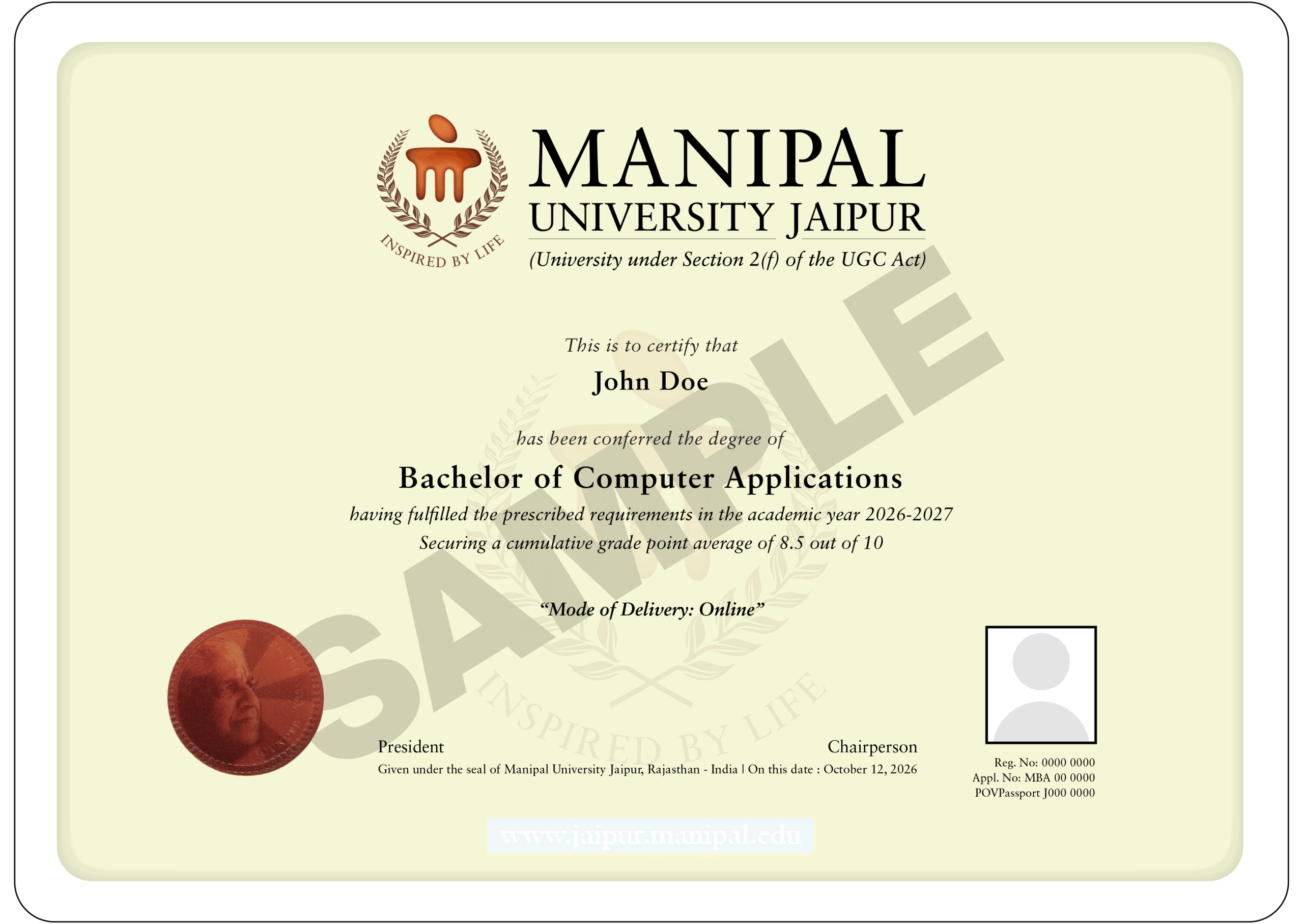
Yes, all eligible students who have successfully fulfilled every criterion will be awarded their degree certificates via in-person convocation in the Sikkim Manipal University campus or mailed via courier .

How are online BCA programs different from regular BCA courses?

Feature Online BCA Regular BCA Mode of Learning 100% Online via LMS, live and recorded lectures In-person, classroom-based sessions Flexibility Learn anytime, anywhere Fixed schedule, location-bound Work-Study Balance Can study while working Often requires a career break Cost Generally, more affordable Typically, higher due to campus & hostel fees Networking Opportunities Virtual peer interactions & forums Face-to-face networking & campus events Access to Faculty Scheduled live sessions, discussion boards Classroom interaction Recognition UGC-entitled, valid & industry-recognized Equally recognized and valued

Are online degrees by Online Manipal credible and valid?

Yes, all online degree programs offered through Online Manipal are UGC-entitled, making them equivalent to on-campus degrees.

Is this online BCA program compliant with AICTE norms?

Yes, this BCA program is compliant with AICTE norms. However, as per the University Grants Commission (UGC), Central, State and Private Universities offering Undergraduate, Postgraduate & Postgraduate Diploma programs under the disciplines of Management, Computer Applications and Travel & Tourism in online mode do not require AICTE approval.

Can online degrees from Manipal University Jaipur be recognized in all regions of Canada?

Yes, Manipal University Jaipur’s degrees are recognized in Canada. Here are the bodies that evaluates Manipal University Jaipur’s degrees for issuing equivalence certificates . These bodies conduct educational credential assessment (ECA) services for both employers and higher education institutions (HEIs). World Education Services (WES) – Applicable across US and Canada. International Credential Assessment Service of Canada (ICAS)- Applicable across Canada for employment and immigration purposes. ICAS is the only accepted evaluation service for admission to colleges in Ontario province. International Credential Evaluation Service (ICES)- The government-mandated ECA service in British Columbia which also serves the interest of all internationally educated applicants throughout Canada.

Will learners receive placement assistance?

Yes. Online Manipal offers placement assistance to help students with career opportunities upon completion of their programs. The placement cell undertakes initiatives that focus on skill enhancement and skill assessment of the learners to increase their chances of employment.

How much does Coursera access cost?

Learners can opt for Coursera access at a special student price of INR 3,999, compared to the standard market price of INR 13,999 (one-year validity).

How long is the Coursera access valid for?

Coursera access is valid for one year from the date of activation. Learners are encouraged to make the most of this period to complete courses and certifications.

When and how can I activate Coursera access?

You can opt in and activate Coursera access after your admission is approved, either through your student portal or with assistance from your mentor.

Will I have access to Manipal University Jaipur’s alumni network?

Yes. Students of the online degree programs will join the Manipal University Jaipur’s alumni network with all associated privileges. As an alumnus, they can interact with peers and build their professional and personal network with professionals from across the globe. They will be given access to the Manipal University Jaipur alumni portal.

Can I purchase Coursera access later during my program?

Yes, you may choose to opt in for Coursera access at a later stage during your program, subject to availability and applicable terms.

Download Brochure

Call
Call
Chat WhatsApp